
Part 1: RAII vs. Manual Resource Management
How much time have you spent in your career chasing unclosed sockets, unreleased hardware mutexes, or memory leaks?
If you write C for embedded systems, you already know this kind of headache. Handling errors means meticulously cleaning up resources before every single return statement. If you miss just one, your system crashes in production three months later.
Over my 30 years building low-level systems and network architectures at companies like Nortel, Meta, and Intel, I’ve seen this exact bug cost thousands of engineering hours. Today, we are going to fix it permanently by moving from C to modern C++, using a concept called RAII.
RAII stands for Resource Acquisition Is Initialization. It’s a terrible acronym for an incredibly beautiful concept. Let me show you what it replaces.
Take a look at this standard C function. We need to lock a hardware mutex, allocate a temporary buffer, read a sensor, and then unlock the mutex before returning.
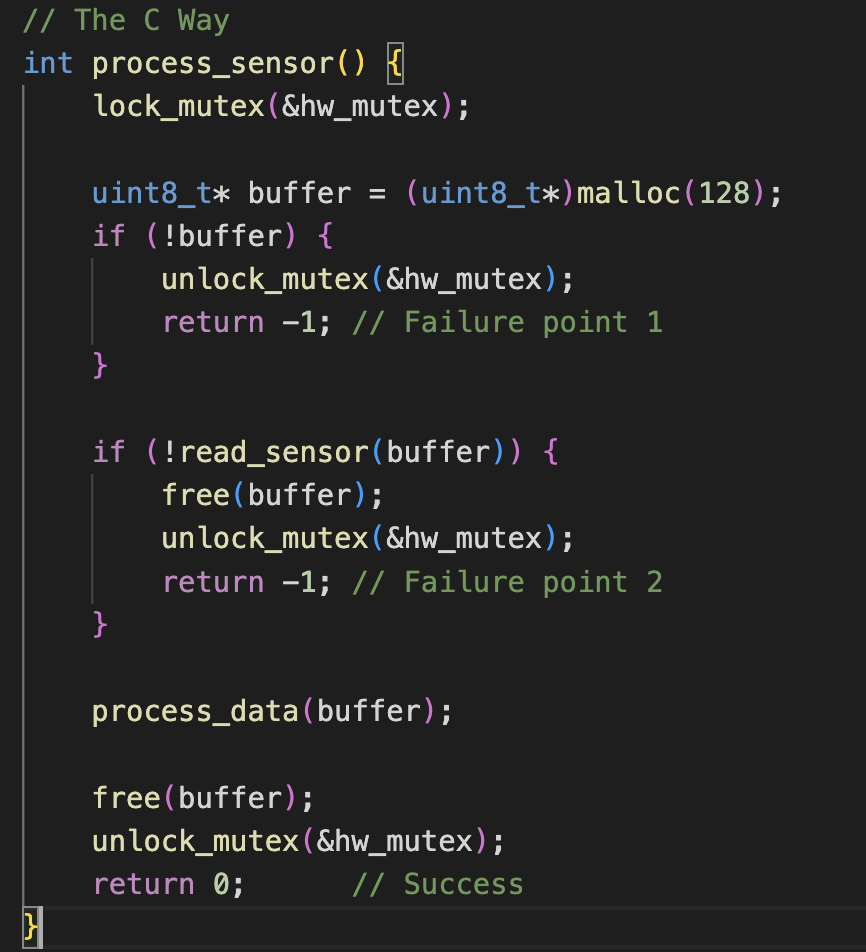
Look at the repetition. Because we have multiple points of failure, we have to manually release the memory and the mutex every single time we exit the function. Some developers try to clean this up using a goto error_cleanup block, but that just creates spaghetti code.
Managing resources in C is like checking out books from a library, and having to manually drive each one back before closing time. If you get distracted and forget, you get a penalty.
RAII is like having a digital library book. The exact millisecond your reading time is up, the book deletes itself from your device. Zero manual overhead. Let’s see how that looks in C++.
In C++, we tie the lifecycle of a resource—like our hardware mutex—to the lifecycle of a local object on the stack. When the object is created, its constructor locks the mutex. When the object goes out of scope, its destructor automatically unlocks it.
Now, watch what happens to our business logic when we use this guard, and replace that risky C malloc with a modern C++ std::array that lives safely on the stack.
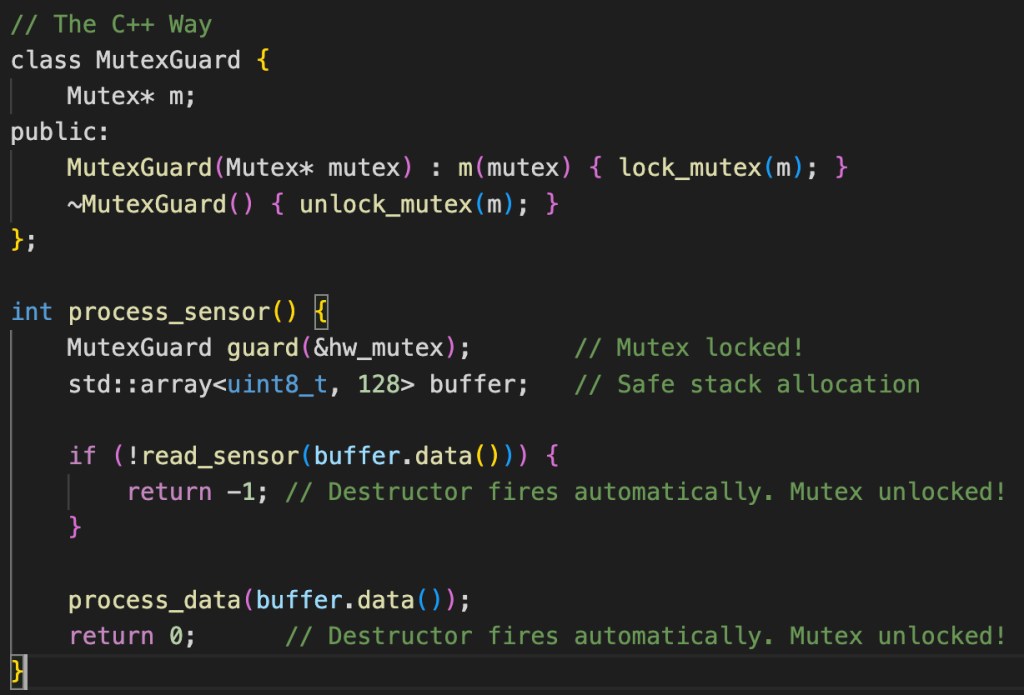
Look at how clean that is. No matter how we exit this function—whether it’s an error or a success—the C++ compiler guarantees that the MutexGuard destructor is called and the mutex is unlocked. The memory leak is physically impossible to write.
Now, I know what the embedded C veterans are thinking right now. “This looks nice, but what is the runtime cost, code size increase of these classes and destructors? I don’t have cycles to use on a microcontroller.”
Here is the best part: it is a zero-cost abstraction.
Because we define the MutexGuard inline, a modern compiler optimizes it perfectly. If you look at the generated assembly code, the C++ version produces the exact same, highly optimized machine instructions as the manual C version. You get absolute safety at compile time, with zero overhead at runtime.
Shifting your mindset from manual resource management to RAII is the single biggest upgrade you can make for your codebase’s reliability.
If you want to see exactly how to write your own zero-overhead RAII wrappers for hardware peripherals, timers, and DMA buffers, I’ve written a book, Modern C++ for Embedded C Engineers, where I go deeper into many of the ideas and techniques we’ve discussed in this series. It’s designed specifically for engineers who want the strict, resource-constrained subset of C++, not the desktop like C++, that belongs on modern embedded devices. You can find more information about the book in the home page.

