
Do you realize that 70% of legacy C embedded codebases have critical security vulnerabilities: memory leak, safety failures, difficult to expand. By industry statistics, over 60% of engineering bandwidth is consumed by the maintenance of those non-reusable legacy systems. If you feel the same pain in your project, this book is for you. It lets you master the zero-cost abstraction provided by modern C++ Object-Oriented Design (OOD), avoid some heavy desktop C++ features, keep your binary as small, efficient and perform as your C code. Hybrid mode let you gain the benefit of C++ and keep the value of your old C codebase investment. Stop writing generic code. Start engineering for performance. This is the definitive bridge from legacy C to high-performance Modern C++, tailored for the engineers defining the future of real-time software for AI-integrated IoT, autonomous vehicles, cloud computing edge device and AR/VR.
This is why I published a new book with the title:
Modern C++ for Embedded C Engineers: The Strategic Bridge to the Future.
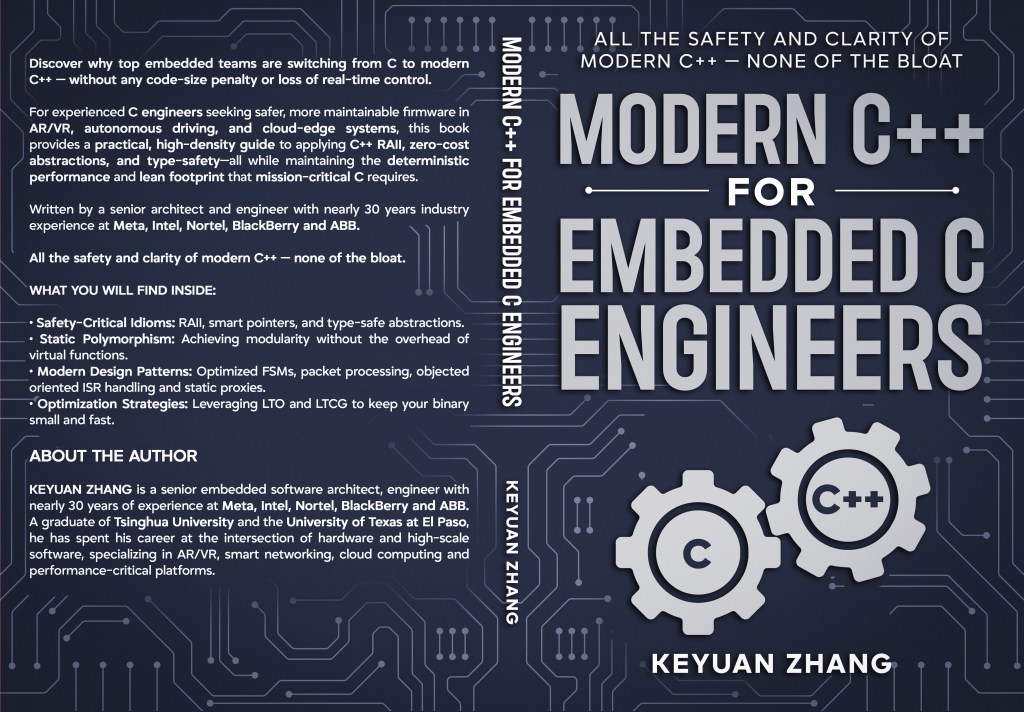
- Why This Book?
While Python dominates the AI “frontend,” the engines—TensorFlow, PyTorch, and llama.cpp—are built on C++. As hardware becomes more software-defined, the gap between legacy C and Modern C++ is closing. Mastery of these skills creates a professional “moat” around your career. In an era of AI automation, the ability to optimize under extreme hardware constraints is the ultimate job security.
It answers following crucial question inside experienced, C embedded engineers’ mind: How to Defuse the Risk Without the Bloat ?
Many engineers avoid C++ due to fears of code-size bloat and execution penalties. This book provides the architectural proof that you can achieve Zero-Cost Safety. Written by a 30-year veteran software engineer and architect (Meta, Intel, Nortel Networks, BlackBerry, ABB), this guide demonstrates how to leverage Modern C++ as a high-performance abstraction layer that integrates seamlessly with your existing C codebases, while strictly avoiding heavy desktop C++ features.
Inside this book, you will master:
High-Performance Infrastructure: Deep dives into RDMA, Smart NIC, and DPDK for cloud networking.
RAII & Resource Management: Eliminate memory leaks by design without runtime overhead.
The Zero-Cost Philosophy: Use abstractions as fast as hand-written C but far safer.
Abstraction without Bloat: Move runtime execution to compile-time using templates and constexpr.
Compile-Time Power: Shrink binaries using LTO and LTCG.
Deterministic Safety: Outperform traditional C designs using std::span and move semantics.
Hybrid Mode: Protect your investment by combining Modern C++ with legacy C APIs.
2. Beyond the Syntax – Built for Real-Time: It is Not Just Another C++ Book. It is A Precision Tool for High-Stakes Engineering.
At first glance, you might think, “The market is already flooded with C++ guides. Why this one?” The answer lies in the constraints. If you are developing for Autonomous Driving, AR/VR, or Mission-Critical Embedded Systems, you know that standard C++ programming is often too “heavy” or “unpredictable” for your needs. This book is different. It is not a generic language manual; it is a tactical manual for environments where memory is a luxury and latency is an enemy.
3. What sets this book apart:
- The “Real-Time” Filter: We don’t just teach Modern C++; we curate it. Discover which high-level features empower your system and which hidden overheads will break it.
- Constraint-First Methodology: Specifically designed for scenarios with limited RAM and extreme computational demands. We summarize the “Must-Haves” and, more importantly, the “Must-Avoids.”
- Mastering the Hybrid Paradigm: Learn the art of “Mixed-Mode” development—integrating C and C++ seamlessly to maintain low-level control while leveraging modern abstraction.
The book’ ebook and paperback version can be ordered at:
https://mybook.to/EmbeddedOODesign
Stop writing generic code. Start engineering for performance. This is the definitive bridge from legacy C to high-performance Modern C++, tailored for the engineers defining the future of real-time software for AI-integrated IoT, autonomous vehicles, cloud computing edge device and AR/VR.
 Engineering Insights: Knowledge, Experience, & Learning