
As an embedded C engineer, you know the shortcomings of using C for complex projects in Autonomous Vehicles, AI-integrated IoT, AR/VR, and cloud edge computing. It is incredibly difficult to scale, maintain, and expand legacy C code. Industry data reveals a sobering reality: 70% of critical security vulnerabilities stem from C’s inherent memory-safety failures. Furthermore, over 60% of engineering bandwidth is wasted on the “Maintenance Tax”—keeping brittle legacy systems on life support. The transition to Modern C++ is no longer optional; it is a requirement for survival.
This is why I published the following book:
Modern C++ for Embedded C Engineers: The Strategic Bridge to the Future.
https://mybook.to/EmbeddedOODesign
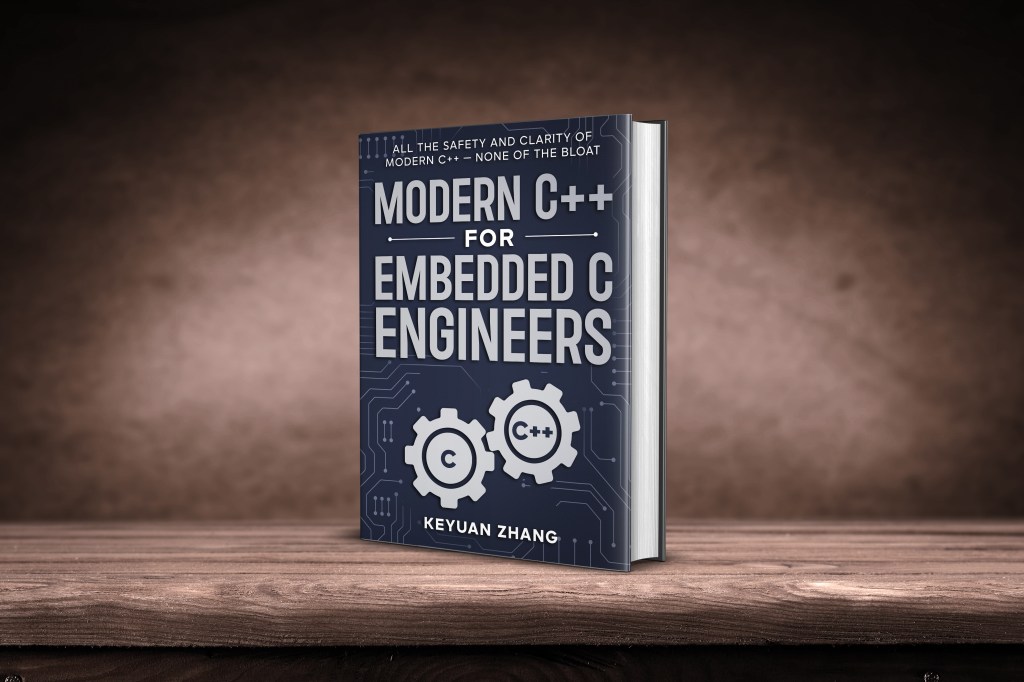
The primary concerns for this transition are code-size bloat and execution speed. Written by an industry expert, this guide demonstrates how to leverage Modern C++ as a high-performance abstraction layer that integrates seamlessly with existing C codebases, keeps your binary small, and runs at native C speed. No desktop bloat—just battle-tested, zero-overhead code.
This book covers typical embedded design use cases with side-by-side C vs. C++ implementation comparisons for memory management, interrupt handling, multitasking, error handling, security, and CI/CD automated testing with hardware mocking. Through empirical profiling, zero-cost abstraction, native performance, and zero code bloat are definitively proven.
Inside this book, you will master:
- Memory & Resource Management: Use RAII to eliminate memory leaks by design without runtime overhead.
- The Zero-Cost Philosophy: Use abstractions as fast as hand-written C but far safer.
- Abstraction without Bloat: Move runtime execution to compile-time using templates and constexpr.
- Compile-Time Power: Shrink binaries using Link-Time Optimization (LTO) and LTCG.
- Deterministic Safety: Outperform traditional C using strong typing and strict enforcement.
- Hybrid Mode: Protect your investment by seamlessly combining Modern C++ with legacy C APIs.
- High-Performance Infrastructure: Implement RDMA, Smart NIC, and DPDK for cloud networking.
- Hardware Mocking: Deploy early-phase unit and automated testing in your CI/CD pipeline.
Key Architectural Matchups (Side-by-Side C vs. C++ Code Comparisons ):
- Memory Management: RAII vs. raw pointers.
- Low-Latency Interrupts: Type-safe callbacks vs. global state.
- Hardware Abstractions: constexpr vs. rigid macro defines.
- Safety and Performance
- CI/CD & Testing: Modular mock targets vs. brittle monoliths.
Who This Book Is For:
Whether you are an embedded C engineer looking to make your projects modular, an architect aiming to design bulletproof systems, a student mastering key embedded concepts, or a developer wanting to bypass years of trial-and-error by studying battle-tested code—this is your definitive guide.
Stop managing legacy risks. Start engineering for the next decade. Upgrade your codebase today.
-
Modern Embedded C++ For C Engineers
As an embedded C engineer, you know the shortcomings of using C for complex projects in Autonomous Vehicles, AI-integrated IoT, AR/VR, and cloud edge computing. It is incredibly difficult to scale, maintain, and expand legacy C code. Industry data reveals a sobering reality: 70% of critical security vulnerabilities stem from C’s inherent memory-safety failures. Furthermore,…

