
Cloud computing provides huge benefits for almost all existing business use cases. XaaS is a popular term in our daily life. Just like computers provide a huge productivity boost for our daily life, it comes with some kind of overhead. Software installation, hardware management, security, system upgrade and update, networking, all kinds of external devices and so on, are all tasks we have to do daily in order to maintain a working, high performance computer system, not to mention when its computing, storage and networking functions are moved into a cloud computing environment. There are tens, hundreds and even thousands of powerful servers involved to provide the so-called XaaS services to end customers.
There are different kinds of Virtual Infrastructure Manager (VIM), such as OpenStack and Kubernetes, to ease this task. They take care of orchestration of user applications’ deployment, monitoring and some degree of high availability, service scale up and down and so on for your applications running inside virtual machines or containers. But, the initial cluster installation, bootstrap and afterward infrastructure software update and upgrade, bug fix , patching are all manual processes which are time consuming, painful and error prone, plus infrastructure’s fault management, fault alarming, adding new compute nodes, cluster wide system resource usage monitoring. Those are values provided by, what is so called “Infrastructure Orchestrator”, for cloud computing. It fulfilled the task to take care of cloud computing infrastructure itself’s installation, monitoring, update and upgrade.
Open sourced edge computing project: StarlingX , seeded from Wind River Cloud Platform, is just such kind an infrastructure orchestrator. Its architecture is illustrated by following diagram:
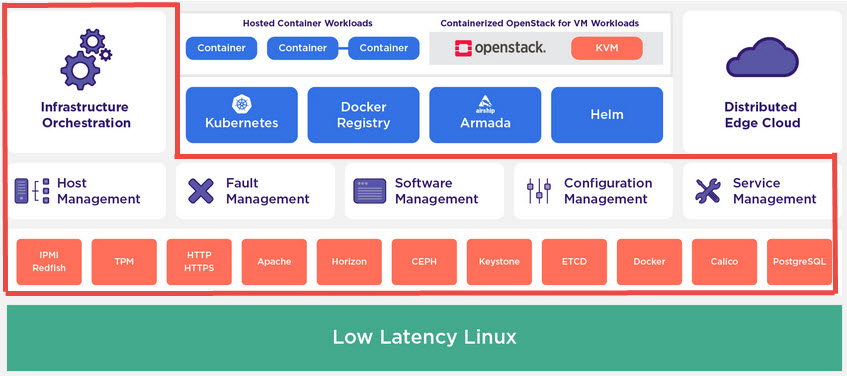
The infrastructure orchestrators are those components within the red box of the above diagram. After the first node of the cluster, usually the system controller, is bootstrapped manually through installation media, it will be configured and put into service using open source technology such as Ansible YAML file descriptively. After this, all necessary cloud computing software components such as container runtime, Kubernetes, database, docker registry, calico networking plug in, Helm, Armada tools are all installed and bringed to the functional stage automatically. This brings the node into a fully functioned, Kubernetes managed platform. After that, adding new controller or compute nodes, configure those, install and update its system software, report any fault, raising any necessary alarm, entire cluster software update and upgrade, operating system patching and upgrade for server hardware, even software update of infrastructure orchestrator itself, are all be taken care by this infrastructure orchestrator in CI/CD way. All those day two cluster management tasks are becoming much easier with significant release cycle reduction.
Infrastructure orchestrator fills the gap between application container or virtual machine management done by Kubernetes or OpenStack and the underline cluster hardware and software management for cloud computing infrastructure.
 Knowledge, Experience and Learning